

CGEIT PDF Dumps Dec 24, 2025 Exam Questions – Valid CGEIT Dumps
Ultimate CGEIT Guide to Prepare Free Latest ISACA Practice Tests Dumps
ISACA Governance of Enterprise IT Exam Syllabus Topics:
| Topic | Details | Weights |
|---|---|---|
| Resource Optimization | - Ensure the optimization of IT resources including information, services, infrastructure and applications, and people, to support the achievement of enterprise objectives. Task Statements
Knowledge Statements
| 15% |
| Framework for the Governance of Enterprise IT | - Ensure the definition, establishment, and management of a framework for the governance of enterprise IT in alignment with the mission, vision and values of the enterprise. Task Statements
Knowledge Statements
| 25% |
| Risk Optimization | - Ensure that an IT risk management framework exists to identify, analyze, mitigate, manage, monitor, and communicate IT-related business risk, and that the framework for IT risk management is in alignment with the enterprise risk management (ERM) framework. Task Statements
Knowledge Statements
| 24% |
| Strategic Management | - Ensure that IT enables and supports the achievement of enterprise objectives through the integration and alignment of IT strategic plans with enterprise strategic plans. Task Statements
Knowledge Statements
| 20% |
NEW QUESTION # 159
Which of the following is MOST important when an IT-enabled business initiative involves multiple business functions?
- A. Defining cross-departmental budget allocation
- B. Conducting a systemic risk assessment
- C. Developing independent business cases
- D. Establishing a steering committee with business representation
Answer: D
Explanation:
Establishing a steering committee with business representation is the most important factor when an IT-enabled business initiative involves multiple business functions, because it ensures that the initiative is aligned with the strategic goals and needs of the organization, and that the different business functions have a voice and a stake in the decision-making process. A steering committee can also provide guidance, support, and oversight to the IT team and help resolve any conflicts or issues that may arise among the business functions. A steering committee can also monitor the progress and performance of the initiative and ensure that it delivers the expected benefits and value to the organization. References := What is an IT Steering Committee? - BMC Software | Blogs, Steering Committee: Definition, Roles & Meeting Tips - ProjectManager, How To Create an IT Steering Committee in 6 Steps - Indeed
NEW QUESTION # 160
Business management is seeking assurance from the CIO that controls are in place to help minimize the risk of critical IT systems being unavailable during month-end financial processing. What is the BEST way to address this concern?
- A. Create a communication plan with risk owners.
- B. Outsource infrastructure hosting.
- C. Develop key risk indicators (KRIs) and action plans.
- D. Restrict and monitor user access.
Answer: C
Explanation:
because this would help to address the concern of business management that controls are in place to help minimize the risk of critical IT systems being unavailable during month-end financial processing. Key risk indicators (KRIs) are metrics that measure the potential impact and likelihood of the risks that may affect the IT performance and outcomes, and provide early warning signals for taking corrective actions12. Action plans are specific steps and tasks that are designed to implement the risk response strategies, such as avoiding, reducing, transferring, or accepting the risks12. Developing KRIs and action plans can help the CIO to monitor and manage the risks of IT system unavailability, and to ensure that the expected benefits and value are realized. Developing KRIs and action plans can also help to communicate and report the risk scenarios and their consequences to business management, and to demonstrate the effectiveness and efficiency of the IT controls12.
NEW QUESTION # 161
An enterprise's internal audit group has scheduled a control review of a payroll system project but has been told to wait until the system is implemented. Which of the following is the GREATEST risk associated with the delay?
- A. delay in the development of new key performance indicators (KPIs)
- B. Lack of adherence to industry best practices
- C. Continued dependency on compliant legacy systems
- D. Increased cost to mitigate deficiencies
Answer: D
Explanation:
Delaying the control review of a payroll system project until after its implementation increases the risk of discovering control weaknesses or errors that could have been prevented or corrected earlier. This would result in increased cost to mitigate the deficiencies and ensure the system's reliability and compliance. Reference: CGEIT Domain 4: Risk Optimization
NEW QUESTION # 162
To enable the development of required IT skill sets for the enterprise, it is MOST important to define skill requirements based on:
- A. a best practices framework.
- B. one set of skills applicable to all IT staff.
- C. training needs.
- D. each role within the IT department.
Answer: D
NEW QUESTION # 163
An enterprise is assessing whether to utilize wearable technology. The enterprise has no prior experience with this technology and has asked the chief technology officer (CTO) to assess the impact to the enterprise. The CTO should FIRST:
- A. understand the enterprise's risk tolerance.
- B. prioritize wearable technology risk.
- C. create an IT risk scorecard.
Answer: A
Explanation:
The CTO should first understand the enterprise's risk tolerance before assessing the impact of wearable technology. This will help the CTO to align the assessment with the enterprise's objectives, culture, and appetite for risk. The other options are important steps in the assessment process, but they are not the first ones. Creating an IT risk scorecard and prioritizing wearable technology risk require a clear understanding of the enterprise's risk tolerance, which is the basis for defining risk criteria and thresholds. References := ISACA, CGEIT Review Manual, 7th Edition, Chapter 2: Strategic Management, Section 2.3: Risk Optimization, p. 63-64.
NEW QUESTION # 164
DRAG DROP
The Information Technology Infrastructure Library (ITIL) is a set of concepts and policies for managing information technology (IT) infrastructure, development, and operations. Drag and drop the ITIL processes that focus on service operation, i.e. operational processes in Service Support, in the correct places.
Select and Place: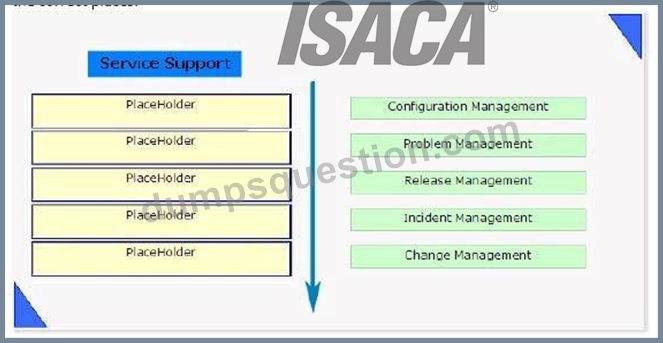
Answer:
Explanation: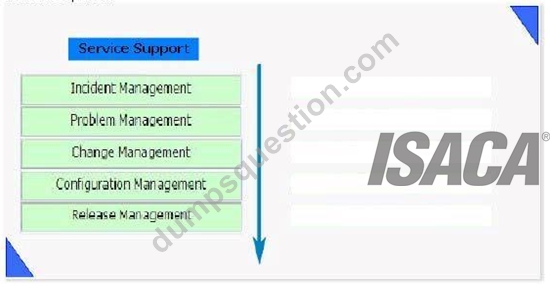
NEW QUESTION # 165
An IT steering committee wants the enterprise's mobile workforce to use cloud-based file storage to save non-sensitive corporate data, removing the need for remote access to that information. Before this change is implemented, what should be included in the data management policy?
- A. A mandate for the encryption of all corporate data files at rest that contain sensitive data
- B. A requirement to scan approved cloud-based apps for inappropriate content
- C. A mandate for periodic employee training on how to classify corporate data files
- D. A process for blocking access to cloud-based apps if inappropriate content is discovered
Answer: B
Explanation:
According to the web search results, a data management policy for cloud-based file storage should include a requirement to scan approved cloud-based apps for inappropriate content. This can help to prevent data leakage, compliance violations, and reputational damage. For example, one of the results1 describes how to use Microsoft Defender for Cloud Apps to create file policies that can monitor and control the data and files in your organization's cloud app use, and apply automated actions for governance and remediation. Another result2 explains how to use Google Cloud Storage's Bucket Lock feature to set a data retention policy for a bucket that governs how long objects in the bucket must be retained, and how to lock the policy to prevent it from being reduced or removed. A third result3 outlines the best practices and approval processes for using cloud computing services at Tufts University, and states that "the university reserves the right to scan any cloud computing service used by Tufts faculty, staff, or students for inappropriate content". Reference:= File policies - Microsoft Defender for Cloud Apps Retention policies and retention policy locks | Cloud Storage | Google Cloud Cloud Computing Services Policy | Technology Services - Tufts University
NEW QUESTION # 166
When evaluating benefits realization of IT process performance, the analysis MUST be based on;
- A. portfolio prioritization criteria.
- B. IT risk policies.
- C. industry standard key performance indicators (KPIs).
- D. key business objectives.
Answer: D
NEW QUESTION # 167
Which of the following is the PRIMARY element in sustaining an effective governance framework?
- A. Ranking of critical business risks
- B. Identification of optimal business resources
- C. Establishment of a performance metric system
- D. Assurance of the execution of business controls
Answer: D
Explanation:
Assurance of the execution of business controls is the primary element in sustaining an effective governance framework, as it ensures that the IT governance processes and activities are performed in accordance with the established policies, standards, and procedures. Assurance also provides feedback and monitoring on the performance, compliance, and outcomes of the IT governance framework, and identifies areas for improvement and optimization12. Reference:= CGEIT Exam Content Outline, Domain 1, Subtopic A: Governance Framework, Task 5: Ensure that assurance processes are established to provide confidence that the IT governance framework is designed and operating effectively.
NEW QUESTION # 168
Which of the following BEST enables effective enterprise risk management (ERM)?
- A. Risk tolerance
- B. Risk ownership
- C. Risk register
- D. Risk training
Answer: A
NEW QUESTION # 169
The PRIMARY reason for an enterprise to adopt an IT governance framework is to:
- A. establish IT initiatives focused on the business strategy.
- B. assure IT sustains and extends the enterprise strategies and objectives.
- C. allow IT to optimize confidentiality, integrity, and availability of information assets.
- D. expedite IT investments among other competing business investments.
Answer: B
Explanation:
IT governance is a framework that provides a formal structure for organizations to ensure that IT investments support business objectives. The primary reason for an enterprise to adopt an IT governance framework is to assure that IT sustains and extends the enterprise strategies and objectives, by aligning IT with business needs, optimizing IT performance and value, managing IT risks and resources, and measuring IT outcomes and benefits12. Reference: ISACA, CGEIT Review Manual, 7th Edition, 2019, page 15. What Is IT Governance? Definition, Practices and Frameworks. IT Governance: Definition, Frameworks, and Best Practices.
NEW QUESTION # 170
An IT value delivery framework PRIMARILY helps an enterprise
- A. optimize value to the enterprise.
- B. improve value of successful IT projects
- C. assist top management in approving IT projects
- D. increase transparency of value to the enterprise
Answer: A
NEW QUESTION # 171
Which of the following BEST facilitates governance oversight of data protection measures?
- A. Information life cycle management
- B. Information ownership
- C. Information custodianship
- D. Information classification
Answer: B
Explanation:
Information ownership is the assignment of roles and responsibilities for data protection to individuals or groups within the organization. Information owners are accountable for ensuring that data is properly classified, secured, and used in accordance with the organization's policies and standards. Information ownership facilitates governance oversight of data protection measures by providing clear lines of authority and accountability for data assets. References:
ISACA CGEIT Review Manual 2021, page 86: "Information ownership is the assignment of roles and responsibilities for the protection of information to individuals or groups within the enterprise." ISACA CGEIT Review Questions, Answers & Explanations Manual 2021, page 11, question 14: "The correct answer is A. Information ownership is the assignment of roles and responsibilitiesfor the protection of information to individuals or groups within the enterprise. Information owners are accountable for ensuring that information is properly classified, secured, and used in accordance with the enterprise's policies and standards. Information ownership facilitates governance oversight of data protection measures by providing clear lines of authority and accountability for information assets."
NEW QUESTION # 172
Which of the following MUST be established before implementing an information architecture that restricts access to data based on sensitivity?
- A. Probability and impact analysis
- B. Security and privacy policies
- C. Risk and control frameworks
- D. Classification and ownership
Answer: D
NEW QUESTION # 173
Which of the following BEST supports enterprise decision making for IT resource allocation?
- A. IT balanced scorecard
- B. Enterprise IT strategy
- C. Enterprise IT risk assessment
- D. IT-related regulatory requirements
Answer: B
Explanation:
An enterprise IT strategy is a plan that defines the vision, mission, goals, and objectives of the IT function in relation to the business needs and expectations of the enterprise. An enterprise IT strategy also outlines the principles, policies, standards, and frameworks that guide the IT governance, management, and operations. An enterprise IT strategy best supports enterprise decision making for IT resource allocation, as it helps to align the IT resources with the business priorities and strategies, and to optimize the value and performance of the IT function and its services. An enterprise IT strategy also helps to identify and prioritize the IT initiatives and investments that can deliver the desired outcomes and benefits for the enterprise, and to allocate the appropriate resources for their execution and delivery. An enterprise IT strategy also helps to monitor and evaluate the results and impacts of the IT resource allocation decisions, and to provide feedback and improvement opportunities. References: CGEIT Exam Content Outline | ISACA1, CGEIT Review Manual (Digital Version), What is an IT Strategy? - Definition from Techopedia2, How to create an effective IT strategy | The Enterprisers Project3
NEW QUESTION # 174
An enterprise is replacing its customer relationship management (CRM) system with a cloud-based system.
Which of the following should be done FIRST when preparing for data migration"*
- A. Acquire data migration tools.
- B. Review the enterprise data architecture.
- C. Consult the quality assurance (QA) function.
- D. Establish a data quality plan
Answer: D
NEW QUESTION # 175
The CIO of a large enterprise has taken the necessary steps to align IT objectives with business objectives.
What is the BEST way for the CIO to ensure these objectives are delivered effectively by IT staff?
- A. Map the IT objectives to an industry-accepted framework.
- B. Include the IT objectives in staff performance plans.
- C. Enhance Ihe budget for training based on the IT objectives.
- D. Include CIO sign-off of the objectives as part of the IT strategic plan.
Answer: C
NEW QUESTION # 176
Which of the following is the MOST efficient approach for using risk scenarios to evaluate a new business opportunity?
- A. Risk identification leverages past audit and compliance reports.
- B. Related risks are consolidated into one scenario for analysis.
- C. Risk events are identified bottom-up and top-down.
- D. Risk scenario narratives are summarized and limited in length.
Answer: C
Explanation:
The most efficient approach for using risk scenarios to evaluate a new business opportunity is to identify risk events from both bottom-up and top-down perspectives. This means that the risk identification process should consider both the specific details of the opportunity, such as the market, customer, product, service, technology, and resources involved, as well as the broader context of the opportunity, such as the strategic objectives, vision, mission, values, and culture of the organization. By using both bottom-up and top-down approaches, the risk identification process can capture a comprehensive and balanced view of the potential risks that could affect the success of the opportunity. This will help to create realistic and relevant risk scenarios that can be analyzed and evaluated for decision-making purposes. A bottom-up approach alone may miss some important risks that are related to the organization's strategy, governance, or environment, while a top-down approach alone may overlook some specific risks that are unique to the opportunity or its implementation. Therefore, a combination of both approaches is the most efficient way to use risk scenarios for evaluating a new business opportunity. := What is business risk? | McKinsey, How to Write Strong Risk Scenarios and Statements - ISACA, Finding your blind spots: Recognising emerging risks and opportunities
NEW QUESTION # 177
To evaluate IT resource management, it is MOST important to define:
- A. IT resource utilization reporting procedures.
- B. principles for the IT strategy.
- C. responsibilities for executing resource management.
- D. applicable key goals.
Answer: D
Explanation:
According to the CGEIT exam guide, IT resource management is the process of planning, acquiring, allocating, monitoring and optimizing the IT resources of an enterprise to support its strategy, objectives and goals. To evaluate IT resource management, it is most important to define the applicable key goals that the IT resources are expected to achieve or contribute to. These key goals should be aligned with the enterprise's vision, mission and values, as well as the stakeholder needs and expectations. The key goals should also be specific, measurable, achievable, relevant and time-bound (SMART), and should be communicated and agreed upon by all relevant parties. Defining the applicable key goals will help to assess the performance, value and impact of IT resource management, as well as to identify the gaps, issues and opportunities for improvement.
The other options are not as important as defining the applicable key goals, as they are more related to the implementation and execution of IT resource management, rather than its evaluation. References: CGEIT Exam Candidate Guide, page 14. CGEIT Certification, IT Resource Management
NEW QUESTION # 178
Which of the following roles should be responsible for data normalization when it is found that a new system includes duplicates of data items?
- A. Application manager
- B. Data steward
- C. Database administrator (DBA)
- D. Business system owner
Answer: C
NEW QUESTION # 179
Which of the following BEST lowers costs and improves scalability from an IT enterprise architecture (EA) perspective?
- A. Cost management
- B. Standardization
- C. IT strategic sourcing
- D. Business agility
Answer: B
Explanation:
Standardization is the best option to lower costs and improve scalability from an IT enterprise architecture perspective, because it reduces complexity, increases interoperability, and enables reuse of IT resources. Reference:= ISACA, CGEIT Review Manual, 27th Edition, 2019, page 79.
NEW QUESTION # 180
The CIO in a large enterprise is seeking assurance that significant IT risk is being proactively monitored and does not exceed agreed risk tolerance levels. The BEST way to provide this ongoing assurance is to require the development of:
- A. a risk management policy.
- B. key risk indicators (KRIs).
- C. a risk register.
- D. an IT risk appetite statement.
Answer: B
NEW QUESTION # 181
You are a management consultant. WebTech Inc., an e-commerce organization, hires you to analyze its SWOT. Which of the following factors will you not consider for the SWOT analysis?
- A. Bandwidth
- B. Product
- C. Promotion
- D. Pricing
Answer: A
NEW QUESTION # 182
Which of the following should be established FIRST so that data owners can consistently assess the level of data protection needed across the enterprise?
- A. Data classification policy
- B. Data retention policy
- C. Data risk management program
- D. Data encryption program
Answer: A
NEW QUESTION # 183
Which conduct stakeholder analysis technique is useful for identifying shared characteristics of a stakeholder group?
- A. Scope modeling
- B. Surveys
- C. Interviews
- D. Brainstorming
Answer: B
Explanation:
Section: Volume A
NEW QUESTION # 184
......
Passing Key To Getting CGEIT Certified Exam Engine PDF: https://www.dumpsquestion.com/CGEIT-exam-dumps-collection.html
Get Top-Rated ISACA CGEIT Exam Dumps Now: https://drive.google.com/open?id=19vDE76b3BmtWdG9fm_vzf31lZ0QrToDi