

IdentityNow-Engineer Free Certification Exam Material from DumpsQuestion with 111 Questions
Use Real IdentityNow-Engineer - 100% Cover Real Exam Questions
NEW QUESTION # 36
The customer has a system that matches the following description. Is this a suitable connector type to use?
The system is a modern, cloud-based, web application that uses a MySQL database backend provided by the cloud platform. The database is only accessible from the web application. The web application exposes a fully compliant SCIM 2.0 interface with OAuth 2.0 client credentials.
Solution: SCIM 2.0 Connector
- A. No
- B. Yes
Answer: B
Explanation:
Yes, the SCIM 2.0 Connector is the most suitable connector for this use case. The system described is a modern, cloud-based web application that exposes a fully compliant SCIM 2.0 interface and uses OAuth
2.0 client credentials for authentication. SCIM (System for Cross-domain Identity Management) is a standardized protocol designed to simplify identity management in cloud applications. The SCIM 2.0 Connector in SailPoint IdentityNow is specifically built to integrate with systems that provide a SCIM interface, making it the ideal connector for this scenario.
References:
* SailPoint IdentityNow SCIM 2.0 Connector Guide.
* SailPoint IdentityNow Cloud-Based Integration Documentation.
NEW QUESTION # 37
Refer to the following diagram.
For this strategy, all virtual appliances (VAs) are deployed in a single VA cluster, with all VAs running concurrently. Some of these VAs are in the primary data center, and others {called OR VAs) are deployed in a DR data center.
While using this strategy, is this a disadvantage?
Solution: A reconfiguration will be required within identityNow to connect to the disaster recovery VAs. If there are many sources configured, this will cause overhead in performing this failover
- A. No
- B. Yes
Answer: A
Explanation:
No, reconfiguration within IdentityNow is not required to connect to the disaster recovery (DR) VAs, which makes this scenario not a disadvantage. When properly configured, all VAs (including DR VAs) in a cluster are part of the same logical unit, meaning that failover to the DR VAs should happen seamlessly without manual intervention or significant reconfiguration. IdentityNow handles the failover automatically, directing traffic to the DR VAs when primary VAs become unavailable.
While there might be some overhead in a manual failover scenario for certain configurations, the use of a single VA cluster helps mitigate this by ensuring the system can failover without needing complex reconfigurations for every source.
References:
* SailPoint IdentityNow Virtual Appliance Failover and Disaster Recovery Configuration.
* SailPoint IdentityNow High Availability Architecture Guide.
NEW QUESTION # 38
Review the following transform:
Can the following output of this transform be expected, based on the input provided in the option?
Solution:
- A. No
- B. Yes
Answer: B
Explanation:
The provided transform is of type "Concat", which means it concatenates values from multiple sources. In this case, it appears to be concatenating the "cn" value with the "displayName" attribute of an identity. The
"type": "IdentityAttribute" section specifies that the transform is pulling the "displayName" attribute from the identity object.
Given the input where the displayName is "Thomas Miller", the expected output is in the format cn=Thomas Miller,ou=users,dc=example, which aligns with the displayed output in the example. The transformation concatenates the displayName value with the rest of the distinguished name (DN), which is a common use case for generating a DN from user attributes.
Key Reference from SailPoint Documentation:
* Concat Transform in IdentityNow: The concat transform is used to join multiple attribute values, and in this example, it successfully creates the expected DN string using the provided displayName input.
NEW QUESTION # 39
What is the required order of steps to implement an identity model for a given authoritative source? Drag the five steps from the left to the answer area on the right, and place them in the coned order. Not all options will be used.
Answer:
Explanation:
Explanation:
To implement an identity model for a given authoritative source, the correct sequence of steps is essential.
Based on the image provided, the five key steps in the correct order are as follows:
* Create a source, and aggregate the data.
* The first step involves setting up the source system and aggregating its data into SailPoint IdentityNow.
* Create an identity profile and associate it to the source.
* After creating the source, an identity profile needs to be created, which will define the identity schema and associate it with the source.
* Define identity mappings, including adding transforms.
* This step involves configuring the mappings between source attributes and IdentityNow attributes, possibly adding transformation logic.
* Preview the identity mappings with aggregated data.
* This step allows you to check how the mappings are applied to actual aggregated data, ensuring correctness.
* Finalize a source create profile.
* Once all configurations are validated, the source profile is finalized, making it ready for production use.
These steps form the required workflow for successfully setting up and implementing an identity model for an authoritative source.
NEW QUESTION # 40
Is this statement true about certification campaigns?
Solution: A certification item can be reassigned multiple times.
- A. No
- B. Yes
Answer: B
Explanation:
Yes, a certification item can be reassigned multiple times during a certification campaign. If a reviewer is unable to certify an item or needs another individual to review the access, they can reassign the certification to a different reviewer. This reassignment functionality allows flexibility in handling access certifications and ensuring the right person evaluates the access. There are no limits on how many times an item can be reassigned, making it a versatile feature within the certification process.
References:
* SailPoint IdentityNow Certification Reassignment Feature Documentation.
* SailPoint IdentityNow Certification Workflow Guide.
NEW QUESTION # 41
Does this run on the VA?
Solution: IQService
- A. No
- B. Yes
Answer: A
Explanation:
IQService does not run on the Virtual Appliance (VA). It is a separate service that must be installed on a Windows Server within the environment that has access to the target system, particularly for Active Directory and other Windows-based systems. IQService acts as a proxy between the IdentityNow tenant and these target systems, allowing operations such as password management and account provisioning to be executed on systems that do not support native connectors on the VA. It communicates with the VA but is not hosted on it.
References:
* SailPoint IdentityNow IQService Installation Guide.
* SailPoint IdentityNow Target Connector Architecture.
NEW QUESTION # 42
Is this statement true about the purpose of a tenant?
Solution: Live access reviews should be performed in a production environment.
- A. No
- B. Yes
Answer: B
Explanation:
Live access reviews, which involve reviewing and certifying user access to various resources, should be performed in a production environment. This is because access reviews are directly related to active identities and entitlements in a live system, ensuring compliance and security in real-time operations.
Key Reference from SailPoint Documentation:
* Access Reviews in Production: SailPoint recommends conducting live access reviews in production environments to ensure that the access being reviewed reflects the actual, current access of users in the system.
NEW QUESTION # 43
Is this statement correct about security and/or encryption of data?
Solution: identityNow uses a hashing algorithm for secure encryption of data in transit and uses TLS for hashing passwords and the answers to security questions
- A. No
- B. Yes
Answer: A
Explanation:
No, this statement is incorrect. While IdentityNow does use TLS (Transport Layer Security) for securing data in transit, TLS is not a hashing algorithm; it is a protocol used for encryption to ensure secure communication over networks. Additionally, IdentityNow uses hashing algorithms for securely storing passwords and answers to security questions (e.g., SHA-256 or bcrypt), but it does not use TLS for hashing these values. Hashing algorithms are one-way functions that help store sensitive data securely by converting them into irreversible fixed-length representations.
TLS protects data during transmission by encrypting it, while hashing is used for securing stored data such as passwords.
References:
* SailPoint IdentityNow Encryption and Security Practices Documentation.
* SailPoint IdentityNow Password Hashing and Encryption Mechanisms Guide.
NEW QUESTION # 44
Review the steps.
1______________________________________
2. Import the virtual appliance (VA) image to the virtualization platform.
3. Start the VA.
4. Log in to the VA using the default credentials.
5. Change the password for the SailPoint user.
6______________________________________
7. Create a new VA cluster in IdentityNow.
8. Create a new VA configuration in IdentityNow. 9 Download / procure the config.yaml.
10. Configure the keyPassphrase in the config.yaml.
11. Upload the config.yaml into the VA.
12______________________________________.
Are these the missing steps?
Solution: 1. Click Test Connection on the VA configuration. 6. Download / procure the VA image. 12.
Configure networking configurations (as needed).
- A. No
- B. Yes
Answer: A
Explanation:
No, the provided steps are not correct. The sequence of actions is misplaced:
* Step 1: Before clicking "Test Connection," you need to download or procure the VA image and import it into the virtualization platform.
* Step 6: After logging in and changing the password, the next step is to configure the networking settings, not downloading the image again.
* Step 12: After uploading the config.yaml, you should proceed with testing the connection to ensure the VA is correctly configured and can communicate with IdentityNow.
Corrected Steps:
* Download / procure the VA image.
* Configure networking configurations (as needed).
* Click Test Connection on the VA configuration.
References:
* SailPoint IdentityNow Virtual Appliance Installation and Configuration Guide.
* SailPoint IdentityNow Virtual Appliance Test Connection Documentation.
NEW QUESTION # 45
Does this run on the VA?
Solution: Active Directory connector
- A. No
- B. Yes
Answer: B
Explanation:
Yes, the Active Directory connector can run on the Virtual Appliance (VA). The VA is responsible for hosting connectors that communicate with various target systems, including Active Directory. The connector establishes the communication between IdentityNow and the target Active Directory instance for operations such as provisioning, deprovisioning, and account synchronization. The VA acts as the bridge between IdentityNow's cloud service and the on-premises AD environment, enabling secure communication through the connector.
References:
* SailPoint IdentityNow Active Directory Connector Configuration Guide.
* SailPoint IdentityNow Virtual Appliance Architecture and Setup Documentation.
NEW QUESTION # 46
Is this an item that an IdentityNow engineer should configure when implementing a source that uses a JDBC connector?
Solution: Select the checkbox to use database admin as service account.
- A. No
- B. Yes
Answer: A
Explanation:
No, selecting a checkbox to use the database admin as the service account is not a recommended or required configuration when implementing a source that uses a JDBC connector. Typically, for security and least privilege, a dedicated service account with only the necessary permissions to read and manage identities within the database is used. Granting database administrator (DBA) privileges to the service account introduces unnecessary security risks and is against best practices.
References:
* SailPoint IdentityNow JDBC Connector Configuration Guide.
* SailPoint IdentityNow Best Practices for Service Accounts Documentation.
NEW QUESTION # 47
When an engineer goes to Global > System Settings and clicks on System Notifications, the following page opens:
What email notifications are enabled if the engineer selects Sources?
Solution: A notification is sent when a source has been in an error state for fifteen minutes.
- A. No
- B. Yes
Answer: B
Explanation:
Yes, SailPoint IdentityNow sends a notification if a source has been in an error state for a sustained period, typically after fifteen minutes. This type of alert helps administrators to be aware of prolonged connection or operational issues with a source, so they can take corrective action promptly. The notification system is designed to escalate issues that may impact synchronization, provisioning, or access-related processes.
Key Reference from SailPoint Documentation:
* Error State Notifications: SailPoint IdentityNow sends alerts for sources in error states, including when the error persists for a predefined period such as 15 minutes, helping administrators to respond to ongoing issues.
NEW QUESTION # 48
Is the following description of an access profile correct?
Solution: It allows definition of an approval process.
- A. No
- B. Yes
Answer: B
Explanation:
Yes, an access profile allows the definition of an approval process. When an access profile is created, administrators can configure specific approval workflows that must be followed before the access is granted.
This includes designating approvers or specifying multiple levels of approval, depending on the organization's policies. This capability is useful for ensuring that sensitive access requests are properly reviewed and approved.
References:
SailPoint IdentityNow Access Request and Approval Workflow Guide.
SailPoint IdentityNow Access Profile Configuration Documentation.
NEW QUESTION # 49
Is the following true about custom connectors in IdentityNow?
Solution: Custom connector are imported the identityNow UI.
- A. No
- B. Yes
Answer: B
Explanation:
Yes, custom connectors are imported into IdentityNow via the UI. After development and testing, the custom connector configuration is uploaded to the platform through the IdentityNow interface. This allows administrators to define how the connector interacts with external systems and specify settings like account aggregation, correlation, and provisioning.
Key Reference from SailPoint Documentation:
* Connector Import Process: Custom connectors are uploaded into IdentityNow through the UI, where they can then be configured and used to connect to external systems.
NEW QUESTION # 50
Match each Virtual Appliance command to Its purpose.
Answer:
Explanation:
Explanation:
1. sudo timedatectl
* Purpose: Display the current system date and time.
2. sudo journalctl -f -u ccsd Of tail /home/sailpoint/ccs.log
* Purpose: Review a log file. This command is used to view logs related to the CCS (Cloud Connector Service) for troubleshooting or analysis.
3. ldapsearch -x -D
* Purpose: Search an Active Directory domain controller. This command queries an LDAP directory to retrieve information about users, groups, etc.
4. nc -vz -w 5 192.168.0.1 80
* Purpose: Test a port on a remote system. This command is using "netcat" to test whether port 80 on the specified IP address is open and responding.
NEW QUESTION # 51
An IdentityNow engineer needs to find identities with disabled AD accounts by using IdentityNow's search features. Is this the correct search syntax to perform this task?
Solution:
- A. No
- B. Yes
Answer: B
Explanation:
Yes, the search syntax @accounts( source.name:"AD" AND state:"disabled" ) is correct for finding identities with disabled AD accounts. In this case, the query filters accounts based on the state being
"disabled," which is valid and effective for identifying disabled accounts.
Key Reference from SailPoint Documentation:
* Search by Account State: Using state:"disabled" is an accurate way to search for disabled accounts in SailPoint IdentityNow.
NEW QUESTION # 52
Can a user with Report-admin level permissions within IdentityNow perform this action?
Solution: invite new users to IdentityNow.
- A. No
- B. Yes
Answer: A
Explanation:
No, a user with Report-admin level permissions cannot invite new users to IdentityNow. The Report-admin role in IdentityNow is restricted to managing reports-this includes generating, viewing, and managing access to reports but does not extend to user management tasks such as inviting new users. Only users with Admin, Org Admin, or other higher-level roles with explicit user management permissions can invite new users to the platform.
References:
* SailPoint IdentityNow Role-Based Access Control Documentation.
* SailPoint IdentityNow Permissions Matrix for Admin Roles.
NEW QUESTION # 53
Is this statement accurate regarding SailPoint's multi-tenant processing environment?
Solution: identityNow admins have the option to choose how often updates to their tenant occur.
- A. No
- B. Yes
Answer: A
Explanation:
No, IdentityNow administrators do not have the option to choose how often updates to their tenant occur.
SailPoint operates a multi-tenant SaaS model, where updates are rolled out centrally by SailPoint on a predefined schedule. SailPoint controls and manages updates to ensure consistency and security across all tenants. This means that all tenants receive updates automatically as part of SailPoint's continuous delivery model, without the ability for individual admins to control or delay updates.
References:
* SailPoint IdentityNow SaaS Release Management Guide.
* SailPoint IdentityNow Multi-Tenant Environment Overview.
NEW QUESTION # 54
An IdentityNow engineer needs to find identities with disabled AD accounts by using IdentityNow's search features. Is this the correct search syntax to perform this task?
Solution:
- A. No
- B. Yes
Answer: A
Explanation:
No, the search syntax @accounts( source.name:"AD" AND disabled:true ) is incorrect for SailPoint IdentityNow because the attribute disabled may not be universally recognized or applicable for all sources in the system. Using the state:"disabled" condition (as in previous correct answers) is a more reliable and system-compliant approach to find disabled accounts.
Key Reference from SailPoint Documentation:
* Standard Account State Search: The correct search syntax involves using state:"disabled" instead of disabled:true for querying disabled accounts.
NEW QUESTION # 55
Exhibit.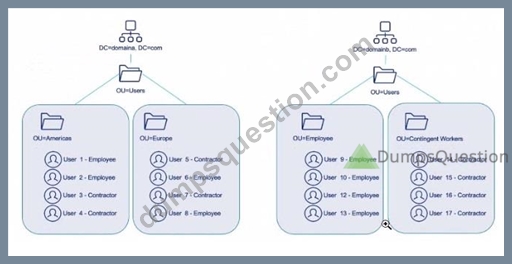
The diagram represents me contents of a single Active Directory forest. Assume that all employees hove employeeType set to employee and contractors have employeeType set to contractor.
is the following configuration valid for the given scenario?
Solution:
The customer needs to query only Employees from Domain A and Contingent Workers from Domain B Fotests:
1. DN - dc=domains, dc=com;TLS =No; Server = server,domaina.com
2. DN - dc=domaininb,dc=com;TLS =No; Server = server,domaina.com
search DNS:
1. DN - OU=users, DC=domains, DC=com; LDAP Filter = (employeeType=employee
2. DN - OU=Contingent Workers, OU=Users, DC=domainb, DC=com
- A. No
- B. Yes
Answer: A
Explanation:
The configuration provided is not valid due to an error in the server specification for Domain B. The server for Domain B (domainb.com) is incorrectly set to server.domaina.com, which is not correct. Each domain in the Active Directory (AD) forest should have its own respective server. For Domain B, the correct server should be something like server.domainb.com, assuming that there are distinct domain controllers for each domain.
Additionally, the search DN for Domain A appears to be valid as it correctly filters for employees with (employeeType=employee). The search DN for Domain B seems to be partially correct, as it targets the OU=Contingent Workers, but the issue lies with the incorrect server assignment.
Key Reference from SailPoint Documentation:
* Active Directory Configuration: Each domain in a forest should be connected to its respective server, and incorrect server assignments between domains can cause LDAP search and synchronization issues.
Proper domain controller assignment for both domaina.com and domainb.com is required.
NEW QUESTION # 56
Is this statement accurate regarding SailPoint's multi-tenant processing environment?
Solution: identityNow admins have the option to choose how often updates to their tenant occur.
- A. No
- B. Yes
Answer: A
Explanation:
No, IdentityNow administrators do not have the option to choose how often updates to their tenant occur. As part of SailPoint's multi-tenant SaaS platform, updates are managed and controlled by SailPoint and are pushed out automatically to all tenants. Administrators do not have the ability to schedule or defer updates, as this ensures all customers are running on the latest and most secure version of the software.
References:
* SailPoint IdentityNow SaaS Release and Update Policy.
* SailPoint IdentityNow Multi-Tenant Environment Overview.
NEW QUESTION # 57
Is this an item that an IdentityNow engineer should configure when implementing a source that uses a JDBC connector?
Solution: This item is complete
- A. No
- B. Yes
Answer: A
Explanation:
No, the statement "This item is complete" is vague and does not represent any actionable configuration when implementing a JDBC connector. An IdentityNow engineer needs to focus on specific technical configurations like setting up schemas, defining SQL queries, mapping attributes, and ensuring the correct service account permissions. Simply stating "This item is complete" is not a valid step in the implementation process.
References:
* SailPoint IdentityNow JDBC Connector Implementation Checklist.
* SailPoint IdentityNow Configuration and Implementation Documentation.
NEW QUESTION # 58
Is this an example of a vanity URL?
Solution: https://my.example.com
- A. No
- B. Yes
Answer: B
Explanation:
Yes, https://my.example.com is an example of a vanity URL. Vanity URLs are customized, branded URLs designed to be easily recognizable, memorable, and aligned with a company's branding. In this case, the subdomain my and the domain example.com create a branded, user-friendly URL. Vanity URLs are often used for simplifying access to services like IdentityNow and for improving user experience.
Key Reference from SailPoint Documentation:
* Vanity URL Usage in IdentityNow: SailPoint allows customers to configure vanity URLs to provide a more personalized and branded login experience for their users.
NEW QUESTION # 59
Is this statement true about the purpose of a tenant?
Solution: A non-production tenant is used for testing new features.
- A. No
- B. Yes
Answer: B
Explanation:
Yes, a non-production tenant is typically used for testing new features before they are deployed to the production environment. This allows administrators to validate functionality, identify potential issues, and ensure the features work as expected without affecting the live users and operations.
Key Reference from SailPoint Documentation:
* Testing New Features in Non-Production: SailPoint advises using non-production environments for testing new functionalities to safeguard production environments from untested changes.
NEW QUESTION # 60
......
SailPoint IdentityNow-Engineer Exam Syllabus Topics:
| Topic | Details |
|---|---|
| Topic 1 |
|
| Topic 2 |
|
| Topic 3 |
|
| Topic 4 |
|
| Topic 5 |
|
Dumps Brief Outline Of The IdentityNow-Engineer Exam: https://www.dumpsquestion.com/IdentityNow-Engineer-exam-dumps-collection.html
IdentityNow-Engineer Training & Certification Get Latest Identity Security Engineer: https://drive.google.com/open?id=1R8H3rnO2f5gn2Fj2dd7pS1f1Tg3lTwJR