

[Apr-2025] Pass Databricks Databricks-Machine-Learning-Associate Exam in First Attempt Guaranteed!
Full Databricks-Machine-Learning-Associate Practice Test and 76 unique questions with explanations waiting just for you, get it now!
NEW QUESTION # 29
Which of the following tools can be used to distribute large-scale feature engineering without the use of a UDF or pandas Function API for machine learning pipelines?
- A. pandas
- B. PvTorch
- C. Spark ML
- D. Keras
- E. Scikit-learn
Answer: C
Explanation:
Spark ML (Machine Learning Library) is designed specifically for handling large-scale data processing and machine learning tasks directly within Apache Spark. It provides tools and APIs for large-scale feature engineering without the need to rely on user-defined functions (UDFs) or pandas Function API, allowing for more scalable and efficient data transformations directly distributed across a Spark cluster. Unlike Keras, pandas, PyTorch, and scikit-learn, Spark ML operates natively in a distributed environment suitable for big data scenarios.
Reference:
Spark MLlib documentation (Feature Engineering with Spark ML).
NEW QUESTION # 30
Which of the following describes the relationship between native Spark DataFrames and pandas API on Spark DataFrames?
- A. pandas API on Spark DataFrames are more performant than Spark DataFrames
- B. pandas API on Spark DataFrames are single-node versions of Spark DataFrames with additional metadata
- C. pandas API on Spark DataFrames are made up of Spark DataFrames and additional metadata
- D. pandas API on Spark DataFrames are less mutable versions of Spark DataFrames
Answer: C
Explanation:
The pandas API on Spark DataFrames are made up of Spark DataFrames with additional metadata. The pandas API on Spark aims to provide the pandas-like experience with the scalability and distributed nature of Spark. It allows users to work with pandas functions on large datasets by leveraging Spark's underlying capabilities.
Reference:
Databricks documentation on pandas API on Spark: pandas API on Spark
NEW QUESTION # 31
A data scientist has produced three new models for a single machine learning problem. In the past, the solution used just one model. All four models have nearly the same prediction latency, but a machine learning engineer suggests that the new solution will be less time efficient during inference.
In which situation will the machine learning engineer be correct?
- A. When the new solution requires if-else logic determining which model to use to compute each prediction
- B. When the new solution requires that each model computes a prediction for every record
- C. When the new solution's models have an average latency that is larger than the size of the original model
- D. When the new solution requires the use of fewer feature variables than the original model
- E. When the new solution's models have an average size that is larger than the size of the original model
Answer: B
Explanation:
If the new solution requires that each of the three models computes a prediction for every record, the time efficiency during inference will be reduced. This is because the inference process now involves running multiple models instead of a single model, thereby increasing the overall computation time for each record.
In scenarios where inference must be done by multiple models for each record, the latency accumulates, making the process less time efficient compared to using a single model.
Reference:
Model Ensemble Techniques
NEW QUESTION # 32
A data scientist has a Spark DataFrame spark_df. They want to create a new Spark DataFrame that contains only the rows from spark_df where the value in column price is greater than 0.
Which of the following code blocks will accomplish this task?
- A. spark_df.filter(col("price") > 0)
- B. SELECT * FROM spark_df WHERE price > 0
- C. spark_df[spark_df["price"] > 0]
- D. spark_df.loc[:,spark_df["price"] > 0]
- E. spark_df.loc[spark_df["price"] > 0,:]
Answer: A
Explanation:
To filter rows in a Spark DataFrame based on a condition, you use the filter method along with a column condition. The correct syntax in PySpark to accomplish this task is spark_df.filter(col("price") > 0), which filters the DataFrame to include only those rows where the value in the "price" column is greater than 0. The col function is used to specify column-based operations. The other options provided either do not use correct Spark DataFrame syntax or are intended for different types of data manipulation frameworks like pandas.
Reference:
PySpark DataFrame API documentation (Filtering DataFrames).
NEW QUESTION # 33
A data scientist has been given an incomplete notebook from the data engineering team. The notebook uses a Spark DataFrame spark_df on which the data scientist needs to perform further feature engineering. Unfortunately, the data scientist has not yet learned the PySpark DataFrame API.
Which of the following blocks of code can the data scientist run to be able to use the pandas API on Spark?
- A. import pyspark.pandas as ps
df = ps.DataFrame(spark_df) - B. spark_df.to_sql()
- C. import pyspark.pandas as ps
df = ps.to_pandas(spark_df) - D. spark_df.to_pandas()
- E. import pandas as pd
df = pd.DataFrame(spark_df)
Answer: A
Explanation:
To use the pandas API on Spark, which is designed to bridge the gap between the simplicity of pandas and the scalability of Spark, the correct approach involves importing the pyspark.pandas (recently renamed to pandas_api_on_spark) module and converting a Spark DataFrame to a pandas-on-Spark DataFrame using this API. The provided syntax correctly initializes a pandas-on-Spark DataFrame, allowing the data scientist to work with the familiar pandas-like API on large datasets managed by Spark.
Reference
Pandas API on Spark Documentation: https://spark.apache.org/docs/latest/api/python/user_guide/pandas_on_spark/index.html
NEW QUESTION # 34
A data scientist is using Spark ML to engineer features for an exploratory machine learning project.
They decide they want to standardize their features using the following code block: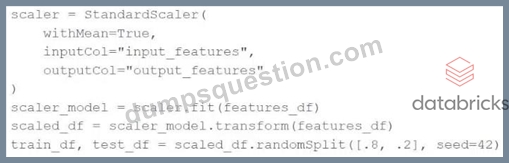
Upon code review, a colleague expressed concern with the features being standardized prior to splitting the data into a training set and a test set.
Which of the following changes can the data scientist make to address the concern?
- A. Utilize the Pipeline API to standardize the test data according to the training data's summary statistics
- B. Utilize the MinMaxScaler object to standardize the training data according to global minimum and maximum values
- C. Utilize the Pipeline API to standardize the training data according to the test data's summary statistics
- D. Utilize the MinMaxScaler object to standardize the test data according to global minimum and maximum values
- E. Utilize a cross-validation process rather than a train-test split process to remove the need for standardizing data
Answer: A
Explanation:
To address the concern about standardizing features prior to splitting the data, the correct approach is to use the Pipeline API to ensure that only the training data's summary statistics are used to standardize the test data. This is achieved by fitting the StandardScaler (or any scaler) on the training data and then transforming both the training and test data using the fitted scaler. This approach prevents information leakage from the test data into the model training process and ensures that the model is evaluated fairly.
Reference:
Best Practices in Preprocessing in Spark ML (Handling Data Splits and Feature Standardization).
NEW QUESTION # 35
A data scientist has written a feature engineering notebook that utilizes the pandas library. As the size of the data processed by the notebook increases, the notebook's runtime is drastically increasing, but it is processing slowly as the size of the data included in the process increases.
Which of the following tools can the data scientist use to spend the least amount of time refactoring their notebook to scale with big data?
- A. pandas API on Spark
- B. Spark SQL
- C. Feature Store
- D. PySpark DataFrame API
Answer: A
Explanation:
The pandas API on Spark provides a way to scale pandas operations to big data while minimizing the need for refactoring existing pandas code. It allows users to run pandas operations on Spark DataFrames, leveraging Spark's distributed computing capabilities to handle large datasets more efficiently. This approach requires minimal changes to the existing code, making it a convenient option for scaling pandas-based feature engineering notebooks.
Reference:
Databricks documentation on pandas API on Spark: pandas API on Spark
NEW QUESTION # 36
An organization is developing a feature repository and is electing to one-hot encode all categorical feature variables. A data scientist suggests that the categorical feature variables should not be one-hot encoded within the feature repository.
Which of the following explanations justifies this suggestion?
- A. One-hot encoding is computationally intensive and should only be performed on small samples of training sets for individual machine learning problems.
- B. One-hot encoding is not a common strategy for representing categorical feature variables numerically.
- C. One-hot encoding is dependent on the target variable's values which differ for each application.
- D. One-hot encoding is not supported by most machine learning libraries.
- E. One-hot encoding is a potentially problematic categorical variable strategy for some machine learning algorithms.
Answer: E
Explanation:
One-hot encoding transforms categorical variables into a format that can be provided to machine learning algorithms to better predict the output. However, when done prematurely or universally within a feature repository, it can be problematic:
Dimensionality Increase: One-hot encoding significantly increases the feature space, especially with high cardinality features, which can lead to high memory consumption and slower computation.
Model Specificity: Some models handle categorical variables natively (like decision trees and boosting algorithms), and premature one-hot encoding can lead to inefficiency and loss of information (e.g., ordinal relationships).
Sparse Matrix Issue: It often results in a sparse matrix where most values are zero, which can be inefficient in both storage and computation for some algorithms.
Generalization vs. Specificity: Encoding should ideally be tailored to specific models and use cases rather than applied generally in a feature repository.
Reference
"Feature Engineering and Selection: A Practical Approach for Predictive Models" by Max Kuhn and Kjell Johnson (CRC Press, 2019).
NEW QUESTION # 37
A data scientist wants to parallelize the training of trees in a gradient boosted tree to speed up the training process. A colleague suggests that parallelizing a boosted tree algorithm can be difficult.
Which of the following describes why?
- A. Gradient boosting is not a linear algebra-based algorithm which is required for parallelization
- B. Gradient boosting calculates gradients in evaluation metrics using all cores which prevents parallelization.
- C. Gradient boosting requires access to all data at once which cannot happen during parallelization.
- D. Gradient boosting is an iterative algorithm that requires information from the previous iteration to perform the next step.
Answer: D
Explanation:
Gradient boosting is fundamentally an iterative algorithm where each new tree is built based on the errors of the previous ones. This sequential dependency makes it difficult to parallelize the training of trees in gradient boosting, as each step relies on the results from the preceding step. Parallelization in this context would undermine the core methodology of the algorithm, which depends on sequentially improving the model's performance with each iteration.
Reference:
Machine Learning Algorithms (Challenges with Parallelizing Gradient Boosting).
Gradient boosting is an ensemble learning technique that builds models in a sequential manner. Each new model corrects the errors made by the previous ones. This sequential dependency means that each iteration requires the results of the previous iteration to make corrections. Here is a step-by-step explanation of why this makes parallelization challenging:
Sequential Nature: Gradient boosting builds one tree at a time. Each tree is trained to correct the residual errors of the previous trees. This requires the model to complete one iteration before starting the next.
Dependence on Previous Iterations: The gradient calculation at each step depends on the predictions made by the previous models. Therefore, the model must wait until the previous tree has been fully trained and evaluated before starting to train the next tree.
Difficulty in Parallelization: Because of this dependency, it is challenging to parallelize the training process. Unlike algorithms that process data independently in each step (e.g., random forests), gradient boosting cannot easily distribute the work across multiple processors or cores for simultaneous execution.
This iterative and dependent nature of the gradient boosting process makes it difficult to parallelize effectively.
Reference
Gradient Boosting Machine Learning Algorithm
Understanding Gradient Boosting Machines
NEW QUESTION # 38
A machine learning engineer would like to develop a linear regression model with Spark ML to predict the price of a hotel room. They are using the Spark DataFrame train_df to train the model.
The Spark DataFrame train_df has the following schema:
The machine learning engineer shares the following code block:
Which of the following changes does the machine learning engineer need to make to complete the task?
- A. They need to convert the features column to be a vector
- B. They need to split the features column out into one column for each feature
- C. They need to utilize a Pipeline to fit the model
- D. They need to call the transform method on train df
- E. They do not need to make any changes
Answer: A
Explanation:
In Spark ML, the linear regression model expects the feature column to be a vector type. However, if the features column in the DataFrame train_df is not already in this format (such as being a column of type UDT or a non-vectorized type), the engineer needs to convert it to a vector column using a transformer like VectorAssembler. This is a critical step in preparing the data for modeling as Spark ML models require input features to be combined into a single vector column.
Reference
Spark MLlib documentation for LinearRegression: https://spark.apache.org/docs/latest/ml-classification-regression.html#linear-regression
NEW QUESTION # 39
A machine learning engineer wants to parallelize the inference of group-specific models using the Pandas Function API. They have developed the apply_model function that will look up and load the correct model for each group, and they want to apply it to each group of DataFrame df.
They have written the following incomplete code block:
Which piece of code can be used to fill in the above blank to complete the task?
- A. applyInPandas
- B. predict
- C. groupedApplyInPandas
- D. mapInPandas
Answer: A
Explanation:
To parallelize the inference of group-specific models using the Pandas Function API in PySpark, you can use the applyInPandas function. This function allows you to apply a Python function on each group of a DataFrame and return a DataFrame, leveraging the power of pandas UDFs (user-defined functions) for better performance.
prediction_df = ( df.groupby("device_id") .applyInPandas(apply_model, schema=apply_return_schema) ) In this code:
groupby("device_id"): Groups the DataFrame by the "device_id" column.
applyInPandas(apply_model, schema=apply_return_schema): Applies the apply_model function to each group and specifies the schema of the return DataFrame.
Reference:
PySpark Pandas UDFs Documentation
NEW QUESTION # 40
A data scientist has developed a linear regression model using Spark ML and computed the predictions in a Spark DataFrame preds_df with the following schema:
prediction DOUBLE
actual DOUBLE
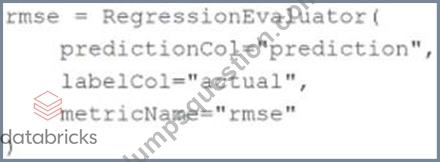
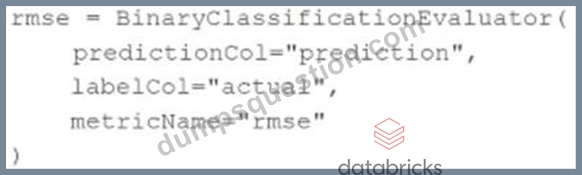
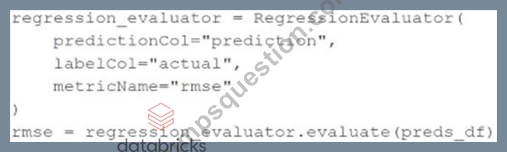
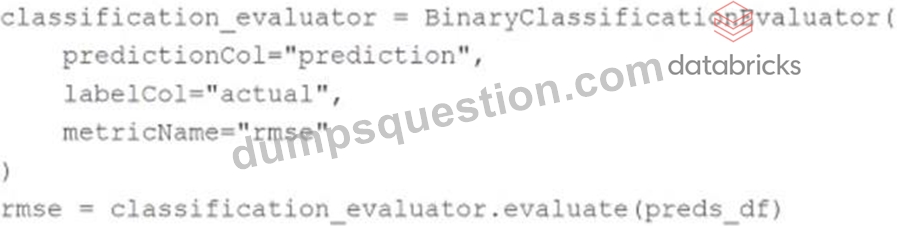
Which of the following code blocks can be used to compute the root mean-squared-error of the model according to the data in preds_df and assign it to the rmse variable?
- A.
- B.
- C.
- D.
Answer: C
Explanation:
To compute the root mean-squared-error (RMSE) of a linear regression model using Spark ML, the RegressionEvaluator class is used. The RegressionEvaluator is specifically designed for regression tasks and can calculate various metrics, including RMSE, based on the columns containing predictions and actual values.
The correct code block to compute RMSE from the preds_df DataFrame is:
regression_evaluator = RegressionEvaluator( predictionCol="prediction", labelCol="actual", metricName="rmse" ) rmse = regression_evaluator.evaluate(preds_df) This code creates an instance of RegressionEvaluator, specifying the prediction and label columns, as well as the metric to be computed ("rmse"). It then evaluates the predictions in preds_df and assigns the resulting RMSE value to the rmse variable.
Options A and B incorrectly use BinaryClassificationEvaluator, which is not suitable for regression tasks. Option D also incorrectly uses BinaryClassificationEvaluator.
Reference:
PySpark ML Documentation
NEW QUESTION # 41
A data scientist is using the following code block to tune hyperparameters for a machine learning model: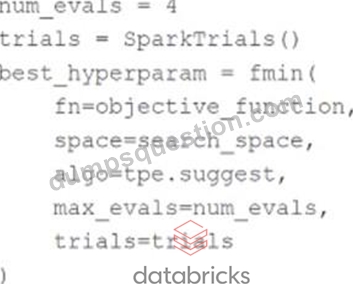
Which change can they make the above code block to improve the likelihood of a more accurate model?
- A. Increase num_evals to 100
- B. Change sparkTrials() to Trials()
- C. Change tpe.suggest to random.suggest
- D. Change fmin() to fmax()
Answer: A
Explanation:
To improve the likelihood of a more accurate model, the data scientist can increase num_evals to 100. Increasing the number of evaluations allows the hyperparameter tuning process to explore a larger search space and evaluate more combinations of hyperparameters, which increases the chance of finding a more optimal set of hyperparameters for the model.
Reference:
Databricks documentation on hyperparameter tuning: Hyperparameter Tuning
NEW QUESTION # 42
A machine learning engineer is trying to scale a machine learning pipeline by distributing its single-node model tuning process. After broadcasting the entire training data onto each core, each core in the cluster can train one model at a time. Because the tuning process is still running slowly, the engineer wants to increase the level of parallelism from 4 cores to 8 cores to speed up the tuning process. Unfortunately, the total memory in the cluster cannot be increased.
In which of the following scenarios will increasing the level of parallelism from 4 to 8 speed up the tuning process?
- A. When the entire data can fit on each core
- B. When the tuning process in randomized
- C. When the model is unable to be parallelized
- D. When the data is particularly long in shape
- E. When the data is particularly wide in shape
Answer: A
Explanation:
Increasing the level of parallelism from 4 to 8 cores can speed up the tuning process if each core can handle the entire dataset. This ensures that each core can independently work on training a model without running into memory constraints. If the entire dataset fits into the memory of each core, adding more cores will allow more models to be trained in parallel, thus speeding up the process.
Reference:
Parallel Computing Concepts
NEW QUESTION # 43
A machine learning engineer is trying to perform batch model inference. They want to get predictions using the linear regression model saved at the path model_uri for the DataFrame batch_df.
batch_df has the following schema:
customer_id STRING
The machine learning engineer runs the following code block to perform inference on batch_df using the linear regression model at model_uri: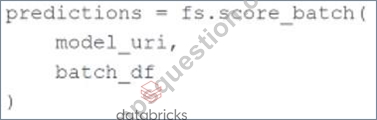
In which situation will the machine learning engineer's code block perform the desired inference?
- A. When all of the features used by the model at model_uri are in a single Feature Store table
- B. When the model at model_uri only uses customer_id as a feature
- C. When all of the features used by the model at model_uri are in a Spark DataFrame in the PySpark
- D. When the Feature Store feature set was logged with the model at model_uri
- E. This code block will not perform the desired inference in any situation.
Answer: D
Explanation:
The code block provided by the machine learning engineer will perform the desired inference when the Feature Store feature set was logged with the model at model_uri. This ensures that all necessary feature transformations and metadata are available for the model to make predictions. The Feature Store in Databricks allows for seamless integration of features and models, ensuring that the required features are correctly used during inference.
Reference:
Databricks documentation on Feature Store: Feature Store in Databricks
NEW QUESTION # 44
A data scientist has replaced missing values in their feature set with each respective feature variable's median value. A colleague suggests that the data scientist is throwing away valuable information by doing this.
Which of the following approaches can they take to include as much information as possible in the feature set?
- A. Remove all feature variables that originally contained missing values from the feature set
- B. Impute the missing values using each respective feature variable's mean value instead of the median value
- C. Create a constant feature variable for each feature that contained missing values indicating the percentage of rows from the feature that was originally missing
- D. Create a binary feature variable for each feature that contained missing values indicating whether each row's value has been imputed
- E. Refrain from imputing the missing values in favor of letting the machine learning algorithm determine how to handle them
Answer: D
Explanation:
By creating a binary feature variable for each feature with missing values to indicate whether a value has been imputed, the data scientist can preserve information about the original state of the data. This approach maintains the integrity of the dataset by marking which values are original and which are synthetic (imputed). Here are the steps to implement this approach:
Identify Missing Values: Determine which features contain missing values.
Impute Missing Values: Continue with median imputation or choose another method (mean, mode, regression, etc.) to fill missing values.
Create Indicator Variables: For each feature that had missing values, add a new binary feature. This feature should be '1' if the original value was missing and imputed, and '0' otherwise.
Data Integration: Integrate these new binary features into the existing dataset. This maintains a record of where data imputation occurred, allowing models to potentially weight these observations differently.
Model Adjustment: Adjust machine learning models to account for these new features, which might involve considering interactions between these binary indicators and other features.
Reference
"Feature Engineering for Machine Learning" by Alice Zheng and Amanda Casari (O'Reilly Media, 2018), especially the sections on handling missing data.
Scikit-learn documentation on imputing missing values: https://scikit-learn.org/stable/modules/impute.html
NEW QUESTION # 45
A data scientist is using Spark SQL to import their data into a machine learning pipeline. Once the data is imported, the data scientist performs machine learning tasks using Spark ML.
Which of the following compute tools is best suited for this use case?
- A. SQL Warehouse
- B. None of these compute tools support this task
- C. Standard cluster
- D. Single Node cluster
Answer: C
Explanation:
For a data scientist using Spark SQL to import data and then performing machine learning tasks using Spark ML, the best-suited compute tool is a Standard cluster. A Standard cluster in Databricks provides the necessary resources and scalability to handle large datasets and perform distributed computing tasks efficiently, making it ideal for running Spark SQL and Spark ML operations.
Reference:
Databricks documentation on clusters: Clusters in Databricks
NEW QUESTION # 46
A data scientist has developed a machine learning pipeline with a static input data set using Spark ML, but the pipeline is taking too long to process. They increase the number of workers in the cluster to get the pipeline to run more efficiently. They notice that the number of rows in the training set after reconfiguring the cluster is different from the number of rows in the training set prior to reconfiguring the cluster.
Which of the following approaches will guarantee a reproducible training and test set for each model?
- A. Set a speed in the data splitting operation
- B. Manually configure the cluster
- C. Write out the split data sets to persistent storage
- D. Manually partition the input data
Answer: C
Explanation:
To ensure reproducible training and test sets, writing the split data sets to persistent storage is a reliable approach. This allows you to consistently load the same training and test data for each model run, regardless of cluster reconfiguration or other changes in the environment.
Correct approach:
Split the data.
Write the split data to persistent storage (e.g., HDFS, S3).
Load the data from storage for each model training session.
train_df, test_df = spark_df.randomSplit([0.8, 0.2], seed=42) train_df.write.parquet("path/to/train_df.parquet") test_df.write.parquet("path/to/test_df.parquet") # Later, load the data train_df = spark.read.parquet("path/to/train_df.parquet") test_df = spark.read.parquet("path/to/test_df.parquet") Reference:
Spark DataFrameWriter Documentation
NEW QUESTION # 47
......
Prepare for your Databricks certification with the updated DumpsQuestion Databricks-Machine-Learning-Associate exam questions: https://drive.google.com/open?id=1hmkJE8fA5ji5JZt3O6kG7y6EAIIjmAsM
Get Latest Databricks-Machine-Learning-Associate Dumps Exam Questions in here: https://www.dumpsquestion.com/Databricks-Machine-Learning-Associate-exam-dumps-collection.html