

PMI-RMP by PMI Actual Free Exam Questions And Answers [UPDATED 2023]
PMI-RMP Questions Truly Valid For Your PMI Exam!
How to book the PMI-RMP Exam
These are following steps for registering the PMI PMI-RMP exam. Step 1: Visit to PMI Exam Registration Step 2: Signup/Login to PMI account Step 3: Select Date and Center of examination and confirm with payment
NEW QUESTION # 40
You work as a project manager for BlueWell Inc. Management has asked you to work with the key project stakeholder to analyze the risk events you have identified in the project. They would like you to analyze the project risks with a goal of improving the project's performance as a whole. What approach can you use to achieve the goal of improving the project's performance through risk analysis with your project stakeholders?
- A. Use qualitative risk analysis to quickly assess the probability and impact of risk events
- B. Involve subject matter experts in the risk analysis activities
- C. Focus on the high-priority risks through qualitative risk analysis
- D. Involve the stakeholders for risk identification only in the phases where the project directly affects them
Answer: C
NEW QUESTION # 41
A project risk manager is concerned about the low performance of risk management on a mission-critical project. After assessing the situation, the risk manager finds that the communication style may be the main contributor.
What could the project risk manager do to adjust the approach to influence team members to improve performance?
- A. Conduct one-on-one meetings, more frequent follow-up meetings, and implement the management by walking around technique.
- B. Seek hidden agendas, vent frustrations, and allow others to vent frustrations
- C. Use follow-up emails, adopt an open door policy, and ask for feedback
- D. Provide continuous support, counseling, build trust, and open communications
Answer: D
NEW QUESTION # 42
A risk manager is managing risks in a project. During the initial stages of project execution, a new risk is identified. There is a very small chance that this risk will occur and even if it occurs, the impact would be low.
What should the risk manager do with this risk?
- A. Put the risk on the watch list.
- B. Seek guidance from subject matter experts (SMEs).
- C. Inform the stakeholders about this risk.
- D. Ignore this risk as it is not critical.
Answer: A
Explanation:
Explanation
Since the probability and impact the risk are both low, it is appropriate to put the risk on the watch list. This allows the risk manager to monitor the risk without expending significant resources on it.
NEW QUESTION # 43
A risk manager is managing risks of a mission critical application. A subject matter expert (SME) asks the risk manager to treat every single risk identified as an extremely high priority.
What should the risk manager do?
- A. Ask the project sponsor if every risk in the risk register can have the same priority.
- B. Mark every identified risk as an extremely high priority and any future risks as a lower priority.
- C. Agree with the SME, treat every risk with equal priority, and inform all stakeholders.
- D. Perform a sensitivity analysis and determine the correct priority of every identified risk.
Answer: D
Explanation:
Explanation
The risk manager should perform a sensitivity analysis to assess the impact of each risk on the project objectives. This will help in determining the correct priority of every identified risk, ensuring that resources are allocated effectively and that the most critical risks are addressed first.
NEW QUESTION # 44
Where can a project manager find risk-rating rules?
- A. Risk probability and impact matrix
- B. Organizational process assets
- C. Enterprise environmental factors
- D. Risk management plan
Answer: B
NEW QUESTION # 45
You are the project manager of the NJJ project. Your enterprise environmental factors require that you establish certain risk management rules regarding low risks within your project. What is the best policy for risks with low probability and low impact in the project management?
- A. These risks should be accepted.
- B. These risks should be placed in the risk register.
- C. These risks should be identified, but dismissed.
- D. These risks should be placed on awatchlist for future monitoring.
Answer: D
NEW QUESTION # 46
You are the project manager for Genpact Inc. You have established quarterly risk management meetings. Which of the following is not a component of a risk management meeting?
- A. The availability of the individual
- B. Assessment or risk
- C. Review of risk responses
- D. Assessing the overall status of risks in the project
Answer: A
NEW QUESTION # 47
A project manager has determined that an activity is too complex to complete internally so they hire a licensed contractor to complete the work. What is the project manager performing in this situation?
- A. Risk avoidance
- B. Risk acceptance
- C. Risk transfer
- D. Risk mitigation
Answer: C
Explanation:
Explanation
By hiring a licensed contractor to complete the complex activity, the project manager is transferring the risk associated with that activity to the contractor. This is an example of risk transfer, as the responsibility for managing the risk is shifted from the project manager to the contractor.
NEW QUESTION # 48
You are the project manager of a large project that will last four years. In this project, you would like to model the risk based on its distribution, impact, and other factors. There are three modeling techniques that a project manager can use to include both event-oriented and project-oriented analysis. Which modeling technique does NOT provide event-oriented and project-oriented analysis for identified risks?
- A. Sensitivity analysis
- B. Jo-Hari Window
- C. Modeling and simulation
- D. Expected monetary value
Answer: B
NEW QUESTION # 49 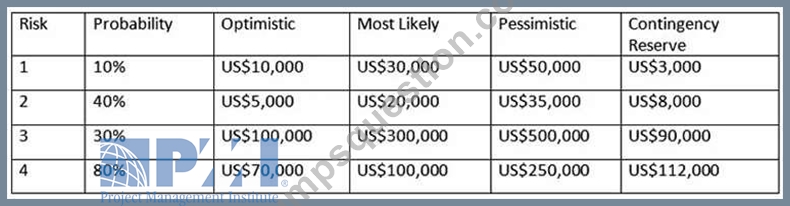
Contingency Reserve Total: US$213,000
Due to a mitigation strategy, Risk 4's probability has been reduced to 40%. What would be the new contingency reserve total?
- A. Unable to calculate a total due to lack of pertinent information.
- B. US$157,000
- C. US$145,800
- D. US$92,400
Answer: B
NEW QUESTION # 50
Which of the following describes a difference between qualitative and quantitative risk analysis?
- A. Quantitative risk analysis adds to the risk register, qualitative risk analysis leads to quantitative risk analysis.
- B. Qualitative risk analysis addresses individual risks descriptively; quantitative risk analysis predicts likely project outcomes based on combined effects of risks.
- C. Quantitative risk analysis prioritizes individual risks for subsequent treatment, qualitative risk analysis leads to quantitative risk analysis.
- D. Quantitative risk analysis addresses individual risks descriptively; qualitative risk analysis predicts likely project outcomes based on combined effects of risks.
Answer: B
NEW QUESTION # 51
A project manager wants to represent the distribution of uncertainty around a risk model element. However, good data on the variability, of the risk model element has not been collected, and only contains minimum and maximum values.
What curve should the project manager use to represent the distribution?
- A. Lognormal
- B. Uniform
- C. Beta
- D. Normal
Answer: C
NEW QUESTION # 52
Pete works as a project manager for BlueWell Inc. The Management has told him that he must implement an agreed-upon contingency response if the cost performance index in his project is less than 0.90. Consider that Pete's project has a budget at completion of $275,000. His project is 65 percent complete and he has spent
$175,000 to date. However, Pete is scheduled to be 78 percent complete. What is the cost performance index for this project to determine if the contingency response should happen?
- A. 1.02
- B. 0.90
- C. 0.89
- D. 0.96
Answer: A
NEW QUESTION # 53
A project manager has just been assigned to a new project. The project manager has been tasked by the project sponsor to ensure the project risks are closely managed. The project manager starts with developing the risk management plan.
What is the expected outcome of developing the risk management plan?
- A. Having the ability to identify risks throughout the project.
- B. Defining how risk management will be executed throughout the project.
- C. Documenting the communication strategy for risks throughout the project.
- D. Being able to monitor and control risks throughout the project.
Answer: B
Explanation:
Explanation
The expected outcome of developing the risk management plan is to define how risk management activities will be executed throughout the project. This includes the processes, tools, and techniques that will be used to identify, assess, and manage risks.
NEW QUESTION # 54
The project manager is reviewing the lessons learned from a previous similar project. The previous project was delayed due to the delay in delivery of a gas turbine generator (GTG). Construction of the previous project had to be shut down unexpectedly to wait for the late delivery of the GTG.
What should the project manager do first?
- A. Include the risk in the register and communicate with the stakeholders.
- B. Interview the other project manager to learn more details.
- C. Communicate with the client to provide the previous shutdown plan.
- D. Review and update the project schedule.
Answer: B
Explanation:
Explanation
The project manager should first gather more information about the previous project's issues by interviewing the other project manager. This will help in understanding the root causes of the delay and how to prevent similar issues in the current project before taking further action.
NEW QUESTION # 55
You work as a project manager for SoftTech Inc. You are working with the project stakeholders to begin the qualitative risk analysis process. Which of the following inputs will be needed for the qualitative risk analysis process in your project? Each correct answer represents a complete solution. Choose all that apply.
- A. Cost management plan
- B. Organizational process assets
- C. Project scope statement
- D. Risk register
Answer: B,C,D
NEW QUESTION # 56
You work as the project manager for Bluewell Inc. You are working on NGQQ Projectyou're your company. You have completed the risk analysis processes for the risk events. You and the project team have created risk responses for most of the identified project risks. Which of the following risk response planning techniques will you use to shift the impact of a threat to a third party, together with the responses?
- A. Risk transference
- B. Risk avoidance
- C. Risk acceptance
- D. Risk mitigation
Answer: A
NEW QUESTION # 57
Some project risks are applicable for the project's lifecycle while others risks are only applicable to specific project activities. When should project risks be closed?
- A. When the risk has been realized and can no longer happen again
- B. When iterative data analysis determines the risk is not applicable
- C. When the forecast activity date has been met or exceeded
- D. When the stakeholders agree a risk is no longer applicable
Answer: D
Explanation:
Explanation
Project risks should be closed when the stakeholders agree a risk is no longer applicable. This ensures that risks are actively managed and only relevant risks are considered throughout the project lifecycle.
NEW QUESTION # 58
Which positive risk response best describes a teaming agreement?
- A. Enhance
- B. Exploit
- C. Share
- D. Venture
Answer: C
NEW QUESTION # 59
......
What is the duration of the PMI-RMP Exam
- Format: Multiple choices, multiple answers
- Length of Examination: 3.5 hours
- Number of Questions: 170
Get instant access of 100% real exam questions with verified answers: https://www.dumpsquestion.com/PMI-RMP-exam-dumps-collection.html
PMI-RMP Actual Questions - Instant Download Tests Free Updated Today!: https://drive.google.com/open?id=13oPKzlYKOSHvkoe6iXQHWvGuh3P0dY2x