

[May-2024] Pegasystems PEGACPDC88V1 Actual Questions and Braindumps
Pass PEGACPDC88V1 Exam with Updated PEGACPDC88V1 Exam Dumps PDF 2024
NEW QUESTION # 22
To access a property from an unconnected component, you use the
- A. customer-dot-property construct
- B. component-dot-property construct
- C. property value
- D. dot-property value directly
Answer: B
Explanation:
To access a property from an unconnected component, you use the component-dot-property construct. For example, if you want to access the property .Rank from an unconnected component named ActionRanking, you use ActionRanking.Rank. Verified Reference: Pega Academy - Decisioning Consultant - Accessing properties from unconnected components
NEW QUESTION # 23
U+ Bank, a retail bank, uses the Business Operations Environment to perform business changes. The team members of the Business Content team and Enterprise Capabilities team perform several roles in the change management process.
Select each role on the left and drag it to the task descriptions to which the role corresponds on the right.
Answer:
Explanation:
NEW QUESTION # 24
U+ Bank, a retail bank, uses the business operations environment to perform its business changes. The bank completes these changes by using revision management features of Pega Customer Decision Hub™ and 1:1 Operations Manager.
Customers see credit card offers based on various engagement policies on the U+ Bank website. The bank wants to update the underlying decision strategy of an engagement policy condition.
According to best practices, which statement correctly describes the implementation of the change to fulfill this business requirement?
- A. A next-best-action specialist modifies the decision strategy in 1:1 Operations Manager.
- B. A next-best-action designer modifies the decision strategy in 1:1 Operations Manager.
- C. A next-best-action designer modifies the decision strategy in Customer Decision Hub.
- D. A next-best-action specialist modifies the decision strategy in Customer Decision Hub.
Answer: C
Explanation:
According to the best practice, a next-best-action designer should modify the decision strategy in Customer Decision Hub, because the decision strategy is part of the next-best-action framework that defines how to select and prioritize propositions for each customer. The 1:1 Operations Manager portal is used to manage the engagement policies and propositions, not the decision strategies. Verified Reference: Pega Decisioning Consultant | Pega Academy
NEW QUESTION # 25
MyCo, a mobile company, uses Pega Customer Decision Hub™ to display offers to customers on its website. The company wants to present more relevant offers to customers based on customer behavior. The following diagram is the action hierarchy in the Next-Best-Action Designer.
The company wants to present offers from both the groups and arbitrate across the two groups to select the best offer based on customer behavior.
As a decisioning architect, what must you do to present offers from the two groups?
- A. Set contact limits for both the groups.
- B. Map a real-time container to the Top-level or Issue-level.
- C. Create a decision strategy at the Issue-level
- D. Enable an engagement policy for the second group.
Answer: B
Explanation:
To present offers from the two groups, you must map a real-time container to the Top-level or Issue-level. A real-time container is a configuration that defines how to deliver offers and treatments to a specific channel, such as a website or a mobile app. By mapping a real-time container to the Top-level or Issue-level, you can enable all the offers under that level to be available for delivery through that channel. Verified Reference: Pega Academy - Decisioning Consultant - Configuring real-time containers
NEW QUESTION # 26
U+ Bank's marketing department currently promotes various home loan offers to qualified customers. Now, the bank does not want to show offers on a customer's account page if the customer has already received three home loan offers in the last two weeks.
What do you need to define to implement the business requirement?
- A. Customer contact limits
- B. Applicability rules
- C. Suppression policy
- D. Volume constraints
Answer: C
Explanation:
A suppression policy allows you to define conditions that prevent customers from receiving an action or a group of actions. You can use a suppression policy to implement the requirement that customers do not see home loan offers on their account page if they have already received three home loan offers in the last two weeks. You can configure the suppression policy to suppress the home loan group based on the number of times the customer received any action from that group in the past 14 days. Applicability rules are used to determine whether an action is relevant for a customer based on their profile or context, not based on the number of times they received an action. Customer contact limits are used to limit the number of times a customer can be contacted per channel per time period, not based on the number of times they received an action. Volume constraints are used to limit the number of times an action is presented to customers across one or more channels, not based on the number of times they received an action. Verified Reference: [Certified Pega Decisioning Consultant | Pega Academy], Suppression policies
NEW QUESTION # 27
What does a dotted line from a "Group By" component to a "Filter" component mean?
- A. To evaluate the "Group By" component, the "Filter" component is evaluated first.
- B. A property from the "Group By" is referenced by the "Filter" component.
- C. Information from the "Group By" is copied over to the "Filter" component.
- D. There is a one-to-one relationship between the "Group By" and the "Filter" components.
Answer: B
Explanation:
A dotted line from a "Group By" component to a "Filter" component means that a property from the "Group By" is referenced by the "Filter" component. For example, if you group customers by age and then filter them by average spending, you need to reference a property from the "Group By" component, such as .pxSegment, in the "Filter" component. A dotted line does not indicate a one-to-one relationship, an evaluation order, or a copying of information between components
NEW QUESTION # 28
The U+ Bank marketing department wants to leverage the next-best-action capability of Pega Customer Decision Hub™ on its website to promote new offers to each customer.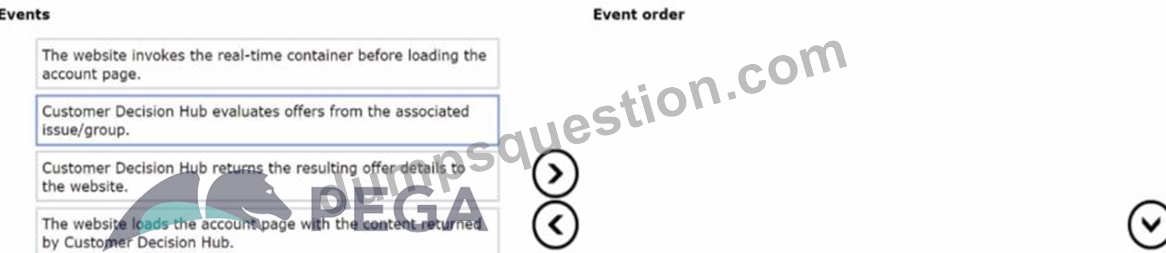
Answer:
Explanation:
1 - The website invokes the real-time container before loading the account page.
2 - Customer Decision Hub evaluates offers form the associated issue/group.
3 - Customer Decision Hub returns the resulting offer details to the website.
4 - The website loads the account page with the content returned by Customer Decision Hub.
NEW QUESTION # 29
U+ Bank has recently implemented Pega Customer Decision Hub™. As a first step, the bank went live with the contact center to improve customer engagement. Now, U+ Bank wants to extend its customer engagement through the web channel. As a decisioning architect, you have created the new set of actions, the corresponding treatments, and defined a new trigger in the Next-Best-Action Designer for the new web channel.
What else do you configure for the new treatments to be present in the next-best-action recommendations?
- A. Modify the Next-Best-Action Framework strategy to cater to the new web channel.
- B. No need to do anything. The strategy is auto-generated.
- C. Change the generated decision strategy.
- D. Create a channel strategy specifically for web.
Answer: B
Explanation:
When you create a new trigger in the Next-Best-Action Designer, Pega Customer Decision Hub automatically generates a decision strategy for that trigger and channel. You do not need to create or modify any strategies manually. Verified Reference: Pega Academy - Decisioning Consultant - Creating triggers
NEW QUESTION # 30
A decisioning architect wants to use the customer properties income and age in a Filter component. Which decision component is required to enable access to these properties?
- A. Set Property
- B. Data Import
- C. None, properties are available
- D. Proposition Data
Answer: B
Explanation:
To enable access to customer properties in a Filter component, you need to use a Data Import component. A Data Import component allows you to read data from various sources, such as data sets, data pages, or data flows, and make it available for other components in the strategy. In this case, you need to use a Data Import component that reads from a customer data source that contains income and age properties. Verified Reference: Pega Academy - Decisioning Consultant - Importing data
NEW QUESTION # 31
In a decision strategy, you can use aggregation components to____________.
- A. make calculations based upon a list of actions
- B. set a text value to a strategy property
- C. filter actions based on priority and relevance
- D. choose between actions
Answer: A
Explanation:
Aggregation components are used to perform calculations on a list of actions, such as sum, average, count, minimum, or maximum. For example, you can use an aggregation component to calculate the total value of all the actions in a group. Verified Reference: Pega Academy - Decisioning Consultant - Aggregating actions
NEW QUESTION # 32
U+ Bank, a retail bank, has recently implemented a project in which credit card offers are presented to qualified customers when they log in to the web self-service portal. The bank added engagement policy conditions to show the offers based on the bank's requirements.
In the Answer Area, select the correct engagement policy for each condition.
Answer:
Explanation:
NEW QUESTION # 33
U+ Bank has decided to use the Pega Customer Decision Hub, M to recommend more relevant banner ads to its customers when they visit the personal portal. Select each placement type on the left and drag it to the correct requirement on the right.
Answer:
Explanation:
NEW QUESTION # 34
U+ Bank has recently defined two contact policies:
1. Suppress a group of credit card offers for 30 days if any credit card offer is rejected three times in any channel in the past 15 days.
2. Suppress the Reward card offer, part of the credit card group, for 7 days if it is rejected twice in any channel in the last 7 days. Paul, an existing U+ Bank customer, no longer sees the Reward card offer. What is the reason that Paul cannot see the offer?
- A. Paul rejected the Reward card offer once on the web channel.
- B. Paul rejected the Reward card offer once in contact center.
- C. Paul rejected other credit card offers twice on the web channel and once in contact center.
- D. Paul rejected other credit card offers once on the web channel and once in the contact center.
Answer: C
Explanation:
Paul cannot see the Reward card offer because he rejected other credit card offers twice on the web channel and once in contact center in the past 15 days. This triggers the first contact policy that suppresses a group of credit card offers for 30 days if any credit card offer is rejected three times in any channel in the past 15 days. The Reward card offer is part of the credit card group, so it is suppressed for Paul for 30 days. The second contact policy that suppresses the Reward card offer for 7 days if it is rejected twice in any channel in the last 7 days does not apply because Paul did not reject the Reward card offer twice in any channel in the last 7 days. Verified Reference: [Certified Pega Decisioning Consultant | Pega Academy], Suppression policies system Following is the description of the image that was sent with question no:5:
This is a screenshot of a table with four columns and two rows.
The table has a header row with white text on a blue background.
The header row reads "Constraint name", "Constraint mode", "Constraint value", and "Channel".
The second row has black text on a white background.
The second row reads "Standard card", "Return any action that does not exceed", "100", and "Daily".
The table has a gray border and a light blue background.
NEW QUESTION # 35
U+ Bank, a retail bank, is cross-selling on the web by showing various credit card offers to its customers.
The bank wants to introduce a new offer in the Business Operations Environment. Place the steps in the correct order of implementation.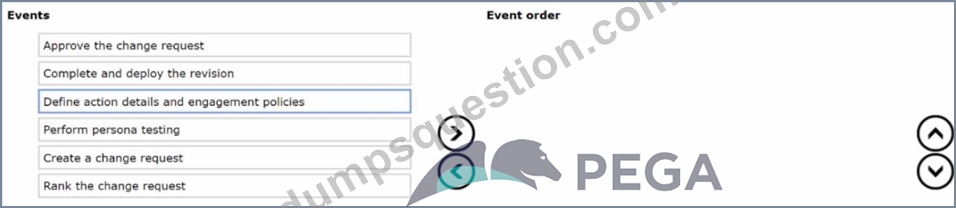
Answer:
Explanation:
1 - Create a change request
2 - Rank the change request
3 - Define action details and engagement policies
4 - Perform persona testing
5 - Approve the change request
6 - Complete and deploy the revision
NEW QUESTION # 36
As a decisioning architect, you are setting up the action hierarchy for MyCo. Select the correct action hierarchy level for each of the hierarchy items identified.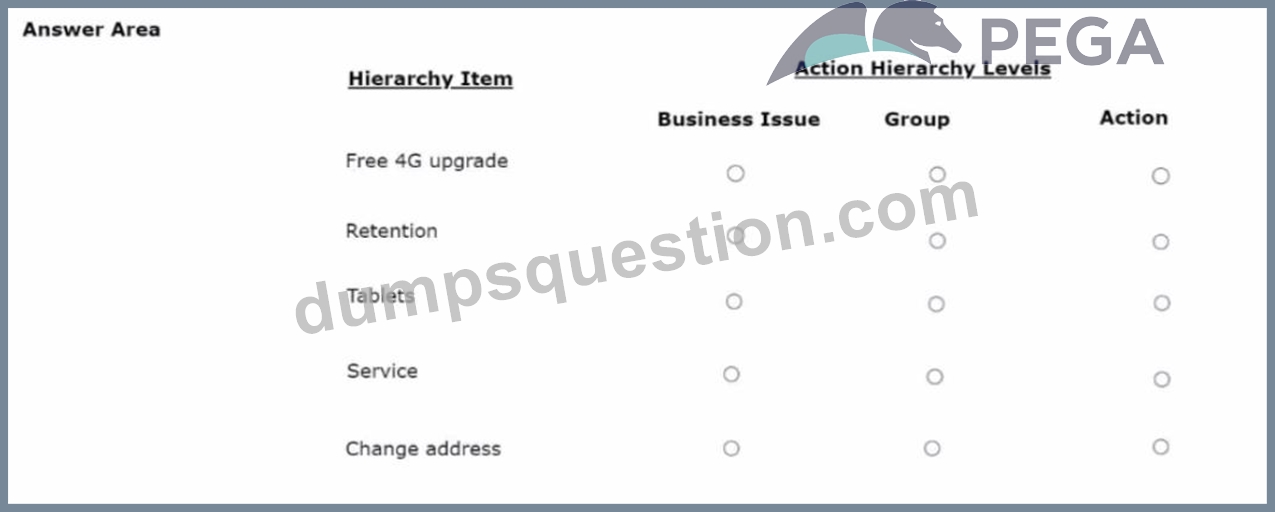
Answer:
Explanation:
NEW QUESTION # 37
U+ Bank wants to use Pega Customer Decision Hub™ to display a credit card offer, the Standard Card, to every customer who logs in to the bank website. What three of the following artifacts are mandatory to implement this requirement7 (Choose Three)
- A. A business structure.
- B. Customer contact policies.
- C. Customer engagement policies.
- D. Real-time containers.
- E. An action and the associated web treatment.
Answer: A,D,E
Explanation:
To implement this requirement, you need to create an action and the associated web treatment, a real-time container, and a business structure. An action is a proposition that you want to present to a customer, such as a credit card offer. A treatment is the way you present the action to a customer, such as an image or a text message. A real-time container is a configuration that defines how to deliver actions and treatments to a specific channel, such as a website or a mobile app. A business structure is a hierarchy of business groups and business issues that organizes actions into meaningful categories. Verified Reference: Pega Academy - Decisioning Consultant - Creating actions and treatments, Pega Academy - Decisioning Consultant - Configuring real-time containers, [Pega Academy - Decisioning Consultant - Defining business structure]
NEW QUESTION # 38
You are a deaccessioning architect on a next-best-action project and are responsible for designing and implementing decision strategies. Select each component on the left and drag it to the correct requirement on the right.
Answer:
Explanation: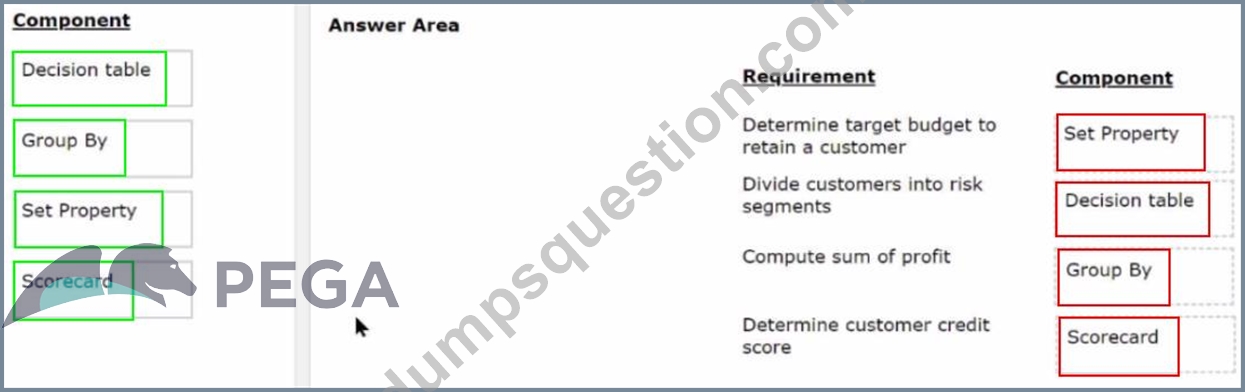
NEW QUESTION # 39
U+ Bank presents various credit card offers to its customers on its website. The bank uses AI to prioritize the offers according to customer behavior. With the introduction of the Gold credit card offer, the offer click-through propensity decreased to 0.42.
What does the decrease in the propensity value most likely indicate?
- A. Similar customers do not qualify for the offer.
- B. Similar customers purchase other offers.
- C. Similar customers ignore the offer.
- D. Similar customers show interest in the offer.
Answer: C
Explanation:
The propensity is a measure of how likely a customer is to accept an offer, based on their attributes and behaviors. The propensity is calculated by using predictive analytics models that learn from historical data and feedback. A low propensity value indicates that the offer is not relevant or attractive for the customer, and that similar customers have ignored or rejected the offer in the past. Therefore, if the offer click-through propensity decreased to 0.42, it most likely indicates that similar customers ignore the offer. Verified Reference: Pega Decisioning Consultant | Pega Academy
NEW QUESTION # 40
......
Latest PEGACPDC88V1 Pass Guaranteed Exam Dumps with Accurate & Updated Questions: https://www.dumpsquestion.com/PEGACPDC88V1-exam-dumps-collection.html
PEGACPDC88V1 Exam Brain Dumps - Study Notes and Theory: https://drive.google.com/open?id=14s3yf_SKxtK6Q1wygPYfmbySKn7FH5bj